
Blog & News
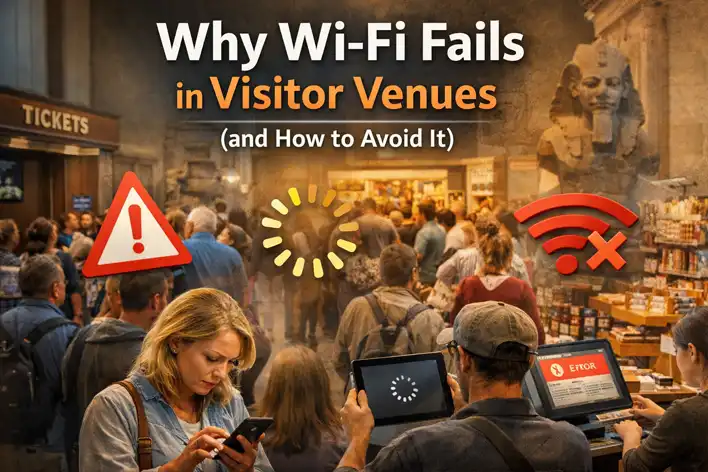
Why Wi-Fi Fails in Visitor Venues (and How to Avoid It)
Visitor attractions, heritage sites and public venues increasingly depend on Wi-Fi to support both visitor experience and day to day operations.
From mobile ticketing and point of sale systems to interactive exhibits, staff devices and guest connectivity, reliable Wi-Fi now underpins far more than just internet access.
Yet many venues still experience slow, unreliable or patchy connectivity, particularly on busy days, not because of dramatic failures, but because the network was never designed for how visitor venues actually behave.
Visitor Venues Behave Very Differently to Offices
In offices, device numbers are relatively stable and usage patterns are predictable.
In visitor attractions, demand arrives in bursts such as coach groups, school visits, wet weather crowding, lunchtime café queues, gift shop rushes and seasonal events.
This means Wi-Fi networks experience sharp spikes in concurrent usage rather than steady averages.
Designs based on floor area alone or typical user numbers often underestimate what is required when it matters most.
Coverage Is Not the Same as Capacity
A common misconception is that if a signal reaches everywhere, the network is good enough.
In reality, coverage simply means devices can connect. Capacity determines whether they can connect reliably and perform properly at the same time.
A single access point might cover a large space, but it can only handle a finite number of active devices before performance drops.
In high density areas such as entrance halls, cafés, retail areas and interactive exhibits, capacity matters far more than signal reach alone.
Why Peak Demand Matters More Than Averages
Many networks are designed around average daily usage.
But visitors do not arrive evenly throughout the day. They arrive in waves, often shaped by transport schedules, weather patterns and event timings.
If a network only just copes on average, it will struggle or fail during these peaks.
This is precisely when staff are busiest, visitors are most engaged, and operational systems are most relied upon.
Operational Systems Depend on the Same Network
Wi-Fi in visitor venues rarely serves visitors alone.
It increasingly supports ticketing, point of sale, handheld scanners, staff communications, monitoring systems and sometimes safety related services.
When the network struggles, the impact is not just a poor visitor experience.
It can directly affect operations, revenue and staff workload.
A Better Way to Start: Plan for Behaviour, Not Just Buildings
Effective Wi-Fi planning for visitor venues starts with understanding how people move, gather and use devices across the site.
This goes beyond simply looking at walls, ceilings and floor plans.
That is why we built the
Wi-Fi Capacity Planner for Visitor Venues.
It provides a practical baseline estimate that reflects peak demand, concurrent usage and high density zones, rather than relying on generic assumptions.
From Estimate to Reliable Design
The planner is a starting point, not a final design.
It helps identify whether your current or proposed network is likely to be under sized, comfortably provisioned, or operating with very little margin.
From there, a proper site survey can confirm placement, account for building materials and layout.
This turns the estimate into a design that performs reliably on your busiest days and not just your quietest ones.
In Summary
- Visitor venues experience bursty, uneven and seasonal demand.
- Coverage alone does not guarantee reliable performance.
- Peak concurrency matters more than daily averages.
- Wi-Fi supports both visitor experience and core operations.
- Planning for behaviour leads to more resilient networks.
Want a Practical Starting Point?
If you would like to understand what this means for your own venue, you can start with the
Wi-Fi Capacity Planner.
You can also speak to us about a site specific survey.
Because good connectivity should feel calm, reliable and well thought through, not fragile or improvised.